India Data Centre Energy Hedging 2026: Tariff Volatility, ToD Risk and BESS Strategy
By Sudarshan Karweer · sudarshan@growthifye.com · +91 84510 99371 (Call / WhatsApp) · 2026-08-27

Data-centre operators in India have spent the last two years debating open access, captive structures, 24/7 matching, BESS ROI and grid interconnection queues. Those topics remain important, but a separate risk layer now deserves board-level attention: energy-price and reliability hedging. In 2026, the commercial outcome for a data-centre campus is increasingly driven not only by average landed power cost, but by exposure to time-of-day tariffs, deviation charges, outage events, curtailment, ancillary charges, contract inflexibility and underperforming backup strategies.
For hyperscale and colocation operators, the energy problem is therefore no longer just procurement. It is portfolio risk management across grid, contract and behind-the-meter assets. This article looks at that missing layer in the Indian context: how a data centre can structure an energy-hedging stack using long-term supply contracts, flexible scheduling, diesel displacement, on-site BESS and operational controls.
Why energy hedging has become a board issue for Indian data centres
India’s data-centre load is growing in clusters where power costs are no longer simple “flat tariff” decisions. Mumbai Metropolitan Region, Chennai, Hyderabad, Bengaluru, NCR and emerging secondary sites are seeing a mix of:
- higher evening and peak-period network stress
- wider time-of-day or time-of-use tariff differentiation
- demand charges that penalise unmanaged ramping
- tighter utility scrutiny of high-density loads
- variability in open-access banking, scheduling and wheeling conditions
- rising expectations from tenants on uptime and carbon performance
For a large facility with 20 MW to 100 MW contracted load, even a Re 0.50/kWh change in effective landed cost can move annual energy spend by several crore rupees. At 50 MW average demand and 95% load factor, annual consumption is about 416 GWh. A Re 0.50/kWh swing on that volume translates to about Rs 20.8 crore per year. If the swing is concentrated in evening peaks or outage events, the business impact can be larger because it also affects SLA risk, diesel consumption and cooling performance.
In 2026, many state discom and regulatory structures make the average tariff less important than the shape of the tariff. A campus that ignores time-block economics may secure a competitive annual average rate while still overpaying during peak import windows. That is why hedging should be approached in the same way operators think about redundancy: as a layered defence, not a single instrument.
The main cost and reliability exposures in 2026
A useful starting point is to identify what exactly needs to be hedged. For Indian data centres, the key exposures are usually the following.
- Time-of-day tariff exposure: Peak-period energy charges can be materially above solar-hour pricing. Depending on state and consumer category, peak premiums of 15% to 35% over off-peak energy charges are not unusual.
- Maximum demand and ramping exposure: Sharp load increases, especially with chiller optimisation changes or tenant fit-out phases, can raise billed demand or create avoidable spikes.
- Open-access balancing risk: Renewable schedules rarely match the data-centre load shape. Shortfalls during non-solar hours can push expensive grid draw unless buffered by storage or contracted firming.
- Deviation and scheduling risk: Where procurement structures rely on forecast accuracy, imbalance costs can erode headline savings.
- Outage and power-quality risk: Voltage dips, feeder outages and transfer events can create business losses far beyond the cost of kWh.
- Diesel price and availability risk: Backup generators remain essential, but their operating cost per kWh is often far above grid or battery discharge cost, especially when run for peak shaving or non-emergency support.
- Curtailment and evacuation risk: Renewable generation linked through open access may face transmission or state-level constraints that reduce effective delivery.
- Policy reset risk: Banking rules, open-access charges, cross-subsidy surcharge trajectories, additional surcharge positions and ISTS-linked economics can all change project economics over a 10- to 20-year term.
Each risk has a different hedge. Trying to solve all of them with one PPA, one battery or one interconnection strategy usually leads to overinvestment.
A practical hedging stack for data-centre campuses
The most resilient structure in India today is a layered stack rather than a single-source model. In practice, many large campuses are moving toward the following architecture.
- Base supply from utility connection with strong redundancy and clear restoration commitments
- Long-term renewable procurement for daytime and annual cost reduction
- Flexible firming product or market-linked balancing for residual gaps
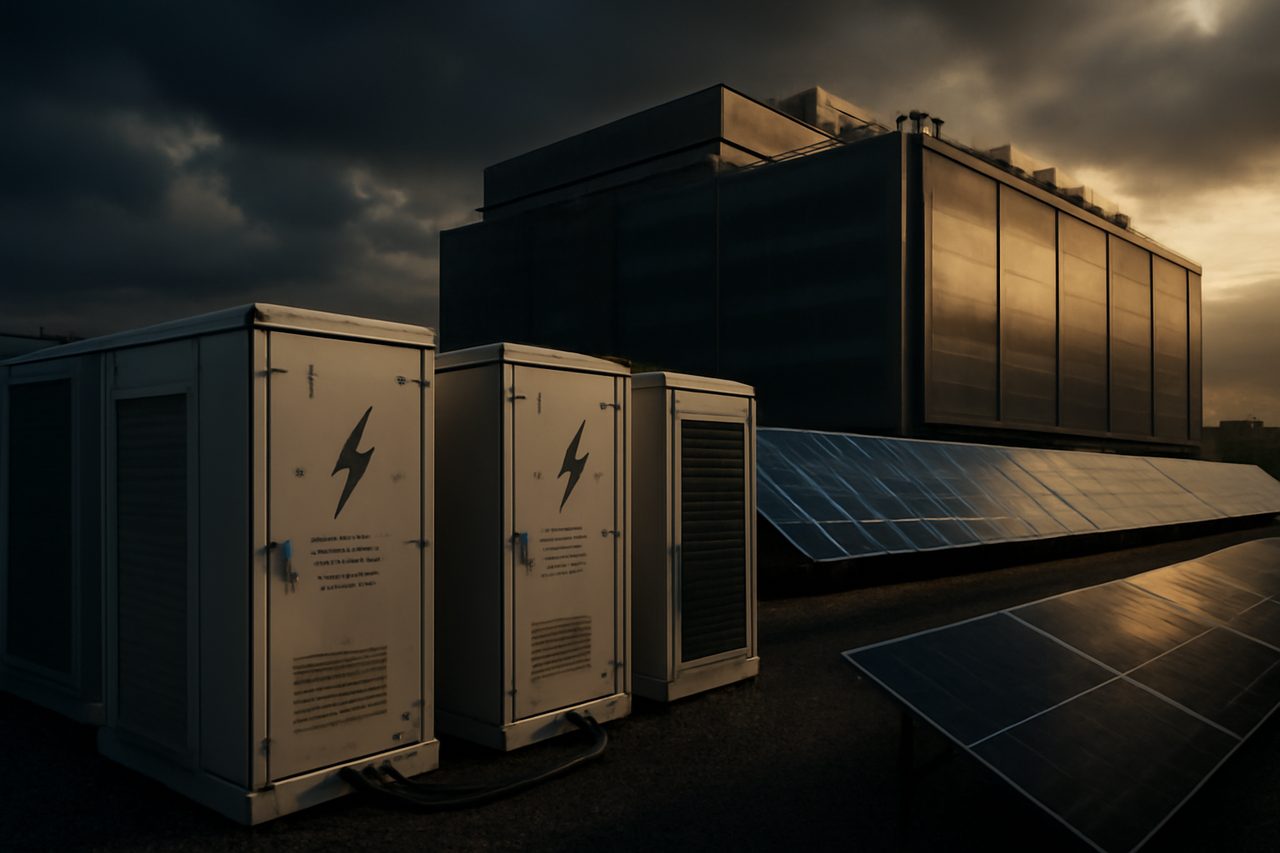
- On-site BESS sized for short-duration reliability and peak-cost management
- Diesel reserved primarily for emergency backup, not routine economic dispatch
- EMS-driven control of load, battery, cooling and import profile
This is where capabilities such as Grid connectivity & redundancy and On-site generation & BESS become commercially linked rather than separate engineering scopes. The right answer is not simply “install a battery” or “sign more solar”. The answer is to assign each layer a specific financial and operational role.
For example, consider a 30 MW IT-load campus with site-level PUE of 1.45. Total average facility demand would be about 43.5 MW. If the operator procures a significant share from open-access solar at landed daytime economics of roughly Rs 4.0 to Rs 5.0/kWh, that may look attractive against utility import at Rs 7.0 to Rs 10.0/kWh equivalent in some industrial and commercial categories. But solar alone will not cover the evening risk window. If 20% to 25% of monthly energy sits in higher-priced evening blocks, the operator may still face a substantial weighted-cost problem unless the evening shape is actively hedged.
A 20 MWh to 60 MWh behind-the-meter BESS can be economically justified even where it does not provide long-duration backup. Its value stack may include:
- peak shaving against time-of-day import tariffs
- reduction in billed demand spikes
- UPS and ride-through support for short grid events
- avoidance of diesel starts for brief disturbances
- support for maintenance switching and power-quality events
- better utilisation of contracted renewable supply through controlled charging windows
In current 2026 conditions, fully installed BESS costs for high-reliability commercial applications will vary by chemistry, integration scope, fire systems, import duties, PCS design and redundancy philosophy, but many large systems still price broadly in the range of Rs 4.5 crore to Rs 6.5 crore per MWh for robust data-centre-grade deployment. For decision-makers, that means battery value must be measured against multiple avoided costs, not just simple energy arbitrage.
How to evaluate ToD arbitrage without fooling yourself
Many battery business cases in India are overstated because they assume perfect cycling and ignore degradation, round-trip losses, partial-charge constraints and tariff complexity. A disciplined analysis should test at least six inputs.
- Daily spread between charge and discharge tariff blocks
- Battery round-trip efficiency, typically 85% to 90% at system level depending on design
- Degradation and usable capacity fade over project life
- Number of economically useful cycles per year rather than theoretical maximum cycles
- Demand-charge reduction in addition to energy-charge savings
- Reliability value from avoided disruptions and reduced diesel operation
Take a simplified example. Suppose a data centre charges a BESS during low-cost midday periods at Rs 4.50/kWh effective energy cost and discharges during evening import periods that would otherwise cost Rs 8.50/kWh. The gross spread is Rs 4.00/kWh. With 88% round-trip efficiency, the effective charged energy cost per delivered kWh becomes about Rs 5.11/kWh before degradation and O&M. The raw arbitrage margin is then around Rs 3.39/kWh delivered. After including augmentation reserve, O&M and cell replacement provisioning, that net margin may fall materially.
If the system performs 250 to 320 high-value cycles per year, the economics can still be attractive, especially when combined with demand-charge reduction and diesel avoidance. But if the same battery is cycled into mediocre tariff spreads just to justify utilisation, returns weaken quickly. This is why dispatch strategy matters as much as capex.
Contract structures that actually hedge risk
Data-centre operators often compare utility tariff, third-party open access and captive procurement as if the goal is to find the cheapest unit rate. In reality, the better question is: which contract combination leaves the least unmanaged cost and uptime exposure over 10 to 15 years?
For 2026, the most useful contract features for data-centre buyers include:
- Clear definition of scheduled versus as-delivered energy
- Firming or shaping options for non-solar and non-windy periods
- Curtailment allocation and deemed-generation treatment where relevant
- Pass-through discipline for change-in-law, transmission and regulatory charges
- Optionality for load growth across phases of a campus
- Exit and step-down provisions aligned to tenant ramp-up uncertainty
- Metering and settlement rules that support hourly or 15-minute visibility
- SLA-linked outage clauses for any dedicated supply arrangements
For high-load campuses, a diversified book is often safer than a monoline strategy. For example:
- 35% to 45% annual energy from utility supply and firm grid connectivity
- 30% to 40% from long-term solar or solar-wind open access or captive structures
- 10% to 20% from wind-heavy or hybrid products to improve evening profile
- residual balancing via short-term market or contracted flexibility
- on-site BESS to shape imports and protect against high-cost or unstable intervals
The exact proportions vary by state, tariff category, land availability, tenant carbon commitments and utility reliability. But the central idea is constant: treat procurement as a portfolio.
This is also where 24/7 clean power contracting becomes more than a sustainability label. For data centres, it can be used as a commercial design principle to reduce expensive uncovered hours rather than merely increase annual renewable percentages.
The role of EMS and cooling controls in hedging power cost
Energy hedging is not only a supply-side exercise. Data centres with strong controls can reduce exposure to expensive time blocks by changing how non-IT loads behave. In many Indian facilities, cooling and auxiliary systems can offer measurable flexibility without compromising white-space conditions.
Practical levers include:
- pre-cooling or thermal strategy adjustments before peak tariff windows
- chiller sequencing optimisation to avoid simultaneous inefficient operation
- pump and fan VFD control tied to tariff and weather signals
- battery charging coordinated with HVAC load valleys
- demand-limit algorithms to prevent avoidable maximum-demand spikes
- transfer-logic tuning to minimise nuisance diesel starts and battery stress
Even a 2% to 4% reduction in total facility energy at a 40 MW to 60 MW campus creates meaningful financial value. If a 50 MW average facility cuts annual consumption by only 3%, that is roughly 13 GWh saved. At an avoided blended cost of Rs 7/kWh, the annual saving is about Rs 9.1 crore. When those savings are concentrated in peak-priced periods, the effective value can be higher.
This is why Load & reliability engineering and Energy management systems should be specified with financial outcomes in mind, not only electrical compliance or dashboard visibility. Good controls convert static assets into a hedgeable portfolio.
What lenders, developers and utilities should watch
The data-centre energy stack is now relevant not just to operators but to every stakeholder around the project.
For lenders:
- Test downside cases for tariff reform, lower banking benefits and delayed open-access approvals
- Examine whether BESS cash flows depend on unrealistic daily cycling assumptions
- Verify that backup architecture separates emergency reliability value from merchant-like arbitrage assumptions
For RE developers and EPC players:
- Offer products that match the customer load shape, not just generation capability
- Build metering, telemetry and settlement architecture that can support granular reconciliation
- Price availability, shaping and curtailment responsibilities transparently
For utilities and regulators:
- Data centres bring stable high-volume demand, but require credible quality-of-supply commitments
- Transparent ToD signals, faster interconnection processing and predictable surcharge trajectories reduce system friction
- Well-designed tariffs can encourage storage and demand shaping without compromising utility cost recovery
In several states, regulators are already moving toward more granular tariffs and sharper accountability around scheduling and network use. That makes ad hoc energy procurement increasingly risky for large data-centre investments.
A 2026 decision framework for operators
If you are evaluating a new campus or expanding an existing one, a practical sequence is:
- map 15-minute load shape for current and expected future phases
- identify utility tariff structure, peak periods, demand-charge mechanics and reliability history
- model renewable procurement by source and season against actual load profile
- quantify the cost of uncovered hours, not just annual shortfall
- size BESS first for reliability events and peak-value intervals, then test arbitrage upside
- integrate cooling, EMS and battery dispatch into one optimisation model
- negotiate contract optionality for expansion, migration and policy change
The most expensive mistake in 2026 is not paying slightly more for supply. It is locking into an inflexible structure that looks cheap in average-rate terms while leaving the campus exposed to peak prices, diesel overuse, poor power quality and non-recoverable interruption costs.
For Indian data centres, the next frontier is therefore disciplined energy hedging: combining tariff intelligence, operational flexibility, robust interconnection and right-sized storage to keep both uptime and cost under control.
If your team is assessing a new site, retrofit or procurement reset, contact Growthifye’s advisory desk for a data-centre energy strategy grounded in Indian tariffs, grid realities and bankable execution.
Explore Growthifye's related capabilities
This analysis connects directly to our advisory practice: Load & reliability engineering · 24/7 clean power contracting · Grid connectivity & redundancy · On-site generation & BESS.
About the author

Founder & CEO, Growthifye — engineering and financing India's clean-energy transition.
Want this analysis applied to your project?
Talk to our team