
Indian DISCOM OT Cybersecurity 2026: Securing AMI, SCADA, ADMS and DER Grid Edge
By Sudarshan Karweer · sudarshan@growthifye.com · +91 84510 99371 (Call / WhatsApp) · 2026-08-25
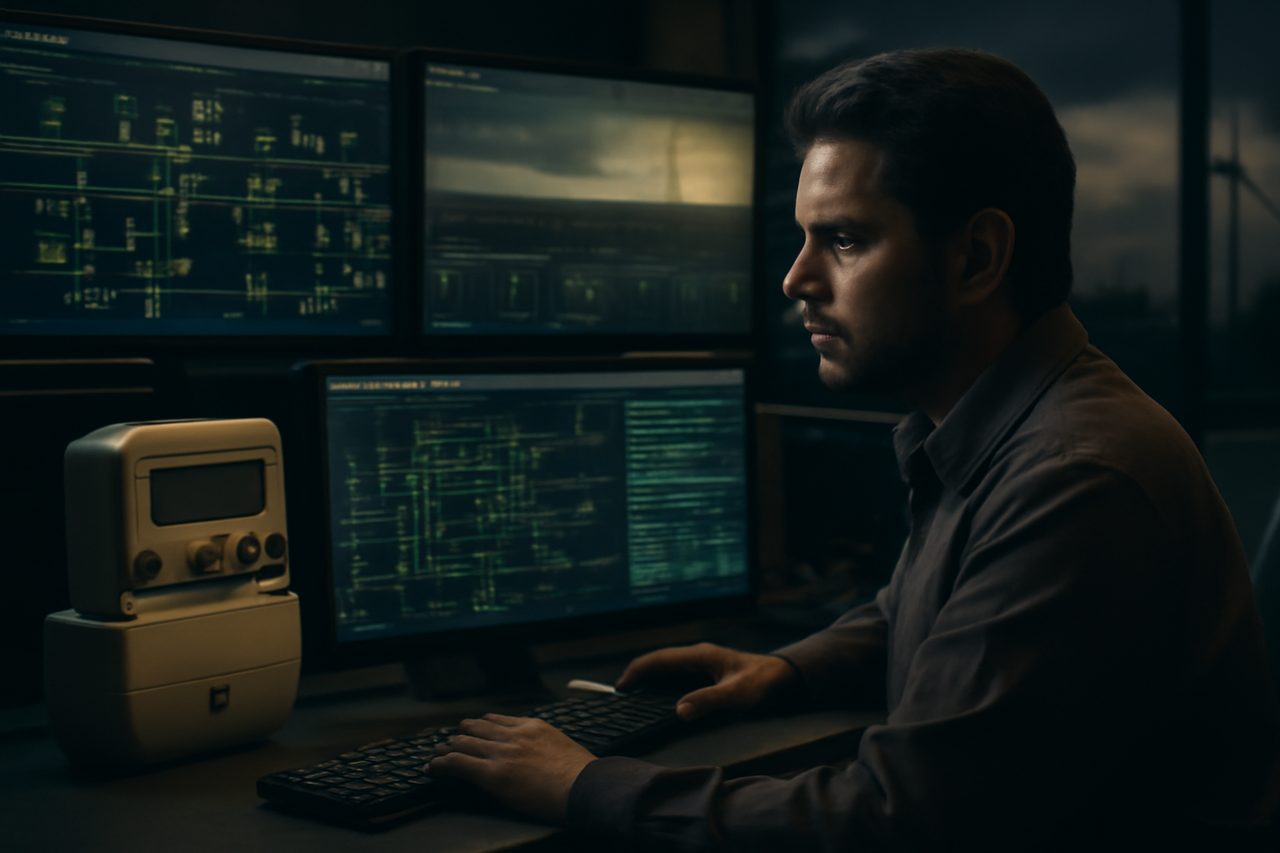
India’s power-distribution digitalisation agenda has moved beyond pilots. By 2026, many DISCOMs are running large AMI rollouts under RDSS, expanding substation automation, integrating SCADA and ADMS, and preparing for higher penetration of rooftop solar, BESS, EV charging and other distributed energy resources. The next constraint is no longer only capex or communications uptime. It is cyber resilience across operational technology, field devices, edge gateways and utility data flows.
For Indian utilities, lenders, EPC players, OEMs, C&I consumers and policymakers, the practical question is simple: how do you digitalise the grid without increasing system-wide operational risk? A smart meter estate of 1 million to 10 million endpoints, a fleet of feeder RTUs, IEC 61850-enabled bays, cloud-hosted analytics and mobile workforce apps create an attack surface that did not exist in legacy distribution systems. A single compromise can trigger billing disruption, outage-management failures, remote disconnect misuse, manipulated load data, false switching commands or substation downtime.
This article focuses on OT cybersecurity for Indian DISCOMs in 2026: what is changing, where the risks sit, which standards and Indian policy frameworks matter, how to scope budgets, and what implementation sequence works in live networks.
Why OT cybersecurity is now a board issue for Indian DISCOMs
Cybersecurity in distribution utilities was historically treated as an IT matter. That approach is no longer adequate. In a digital distribution business, cyber events can directly affect energy accounting, feeder availability, customer billing, collection efficiency, and even safety at substations and DTs.
The economics are material:
- Urban smart metering contracts commonly range from about Rs 6,000 to Rs 9,000 per meter on an all-in basis depending on communication architecture, meter class, HES/MDM scope, consumer indexing complexity and OPEX structure.
- Utility SCADA or ADMS upgrades can run into tens to hundreds of crores depending on city size, control-centre redundancy, integration scope and substation count.
- A 33/11 kV substation automation package with bay control, protection integration, networking and gateway functions can materially raise digital capability, but also expands cyber exposure if not segmented and hardened.
- Billing-system disruptions, tampered meter data or prolonged outage-management failure can affect collections, consumer trust and regulatory performance metrics faster than many utilities expect.
For lenders and state governments, cybersecurity now influences bankability of utility digitalisation because it affects continuity of cash flows, SLA compliance, service quality and reputational risk. For C&I consumers, particularly open-access buyers and industrial clusters relying on stable feeders, cyber resilience at the distribution level matters because it can affect outage restoration time, remote switching quality and accuracy of interval data used for demand analysis.
The Indian utility attack surface in 2026
A modern DISCOM’s digital stack spans much more than meters and control rooms. The core cyber exposure sits across five layers.
- Endpoint layer: smart meters, DCUs, modems, feeder meters, DT meters, relays, IEDs, RTUs, PLCs, inverter interfaces and EV charging controllers.
- Communication layer: RF mesh, cellular APNs, fiber rings, MPLS, serial-to-IP converters, field switches and routers.
- Application layer: HES, MDM, OMS, GIS, billing, CRM, SCADA, ADMS, DERMS, outage apps and analytics platforms.
- Identity layer: users, vendor accounts, device certificates, SIM provisioning, API keys and privileged admin access.
- Supply-chain layer: firmware, OEM remote support tools, third-party integrators, cloud workloads and maintenance laptops.
In India, three field realities amplify the risk.
First, utility networks are hybrid. A DISCOM may simultaneously run legacy serial SCADA, new IP-based substation networks, AMI over cellular, and cloud dashboards. Security controls often differ across each environment.
Second, procurement is fragmented. Meters may come from one vendor, HES from another, MDM from a system integrator, SCADA from a different OEM, and telecom from multiple service providers. Without a common cyber architecture, integration points become weak points.
Third, operational constraints are severe. Many utilities cannot afford long outage windows for patching or network redesign. That means cybersecurity must be engineered into normal operations rather than treated as a one-time hardening exercise.
High-risk use cases: AMI, substation automation and DER integration
Not every digital asset carries the same operational consequence. In practice, Indian DISCOMs should prioritise the systems where compromise can materially affect billing, switching or restoration.
1) AMI and smart metering estates
AMI systems create very large endpoint populations. Risks include:
- Fraudulent remote connect-disconnect commands
- Tampering of load profiles or event logs
- SIM misuse and insecure APN access
- Weak key management for meter authentication
- HES compromise leading to mass command execution
- API exposure between HES, MDM and billing systems
At scale, even a 0.5% issue rate is meaningful. On a 20 lakh meter estate, 0.5% represents 10,000 devices requiring intervention. That is why certificate lifecycle management, secure firmware updates, command signing and role-based controls cannot be deferred.
2) SCADA, ADMS and substation OT
Control-centre compromise can be operationally severe because it affects visibility and switching authority. Common weaknesses include:
- Flat networks between enterprise IT and control systems
- Shared admin credentials across substations
- Insecure remote engineering access for OEM support
- Poor logging retention for IED and gateway activity
- Unpatched Windows or Linux hosts in control applications
- Time-sync issues that weaken event investigation
Where IEC 61850 is deployed, utilities also need to secure engineering workstations, station buses, gateways and configuration files. Goose messaging and process-bus architectures improve automation, but must be combined with segmentation, allow-listing and configuration integrity controls.
3) DER, rooftop solar, BESS and EV charging interfaces
As more generation and flexible load appears at the distribution edge, visibility and control become more complex. A DISCOM integrating prosumers, group captive injections, EV charging depots or utility-scale BESS on urban feeders needs trustworthy telemetry and command pathways. Otherwise:
- Net-load forecasting degrades
- Volt/VAR management becomes less reliable
- Islanding or anti-islanding issues may go unnoticed
- Curtailment instructions may fail or be spoofed
- Restoration after faults can become less predictable
DER cybersecurity is especially relevant in states with high rooftop adoption, commercial solarisation and fast EV infrastructure growth such as Maharashtra, गुजरात, Karnataka, Tamil Nadu, Telangana, Delhi and parts of Uttar Pradesh.
Standards and Indian policy frameworks that matter in 2026
Indian utilities do not need to start from zero. The practical task is to map relevant requirements into distribution OT projects.
Key frameworks include:
- Ministry of Power’s RDSS program requirements for utility modernisation and loss reduction
- CEA cyber security guidelines and advisories applicable to the power sector
- CERT-In directions on logging, incident reporting and cybersecurity practices
- ISO 27001 for information security governance at the enterprise level
- IEC 62443 for industrial automation and control system security
- IEC 62351 for securing power-system communications, especially relevant around IEC 61850 and related protocols
- Sectoral and state-level utility cybersecurity circulars, including vendor-access controls and incident management requirements
For distribution utilities, IEC 62443 is often the most practical engineering reference because it helps define zones, conduits, access controls, patch governance and secure development expectations across OEMs and integrators. IEC 62351 becomes relevant where utilities are scaling IEC 61850, telecontrol and secure key management.
A common mistake is to rely only on compliance checklists. Effective OT security is architecture-led. It should be written into tenders for AMI, SCADA, RTU, SAS, DERMS and telecom packages, not appended after award as a generic clause.
What a workable OT cybersecurity architecture looks like
A distribution utility does not need a military-grade design for every asset. It needs a risk-based model that protects the most consequential systems first.
A workable 2026 architecture generally includes:
- Network segmentation separating enterprise IT, control centre, substation OT, AMI head-end, and vendor access environments
- Zero-trust style identity controls for users, applications and devices, with MFA for all privileged access
- Secure remote access through jump hosts, session recording and time-bound approvals
- PKI or certificate-based device identity for meters, gateways, IEDs and critical APIs where feasible
- Security monitoring through central log collection, OT-aware detection and asset inventory reconciliation
- Backup and recovery playbooks tested for HES, SCADA historians, ADMS servers and configuration repositories
- Application allow-listing and removable-media controls for engineering workstations
- Firmware and patch governance with maintenance windows tied to operational criticality
- Third-party risk controls for OEMs, system integrators and field maintenance contractors
For AMI-heavy DISCOMs, special focus should go to command governance. Every remote disconnect, tariff update, firmware push or clock synchronisation event should be authenticated, logged and exception-monitored. At scale, even low-frequency abuse can create consumer grievance and regulatory exposure.
For substations, the most important step is often simple segmentation plus disciplined remote-access policy. In many cases, this delivers more practical risk reduction than expensive software purchases.
Budgeting, contracting and ROI: what decision-makers should expect
OT cybersecurity budgets in Indian utility projects are often under-scoped. A realistic provision is typically not a token software line item. Depending on project maturity, utilities may need to earmark around 3% to 8% of the relevant digitalisation program value for cyber controls, monitoring, hardening, assessments and training. For highly networked control-centre and substation environments with major legacy remediation, this can be higher.
The ROI is not only about breach avoidance. It shows up in measurable operating outcomes:
- Lower probability of mass meter communication failure from insecure configurations
- Reduced outage duration where secure remote operations remain available during incidents
- Better billing integrity and dispute handling due to tamper-resistant interval data and logs
- Lower vendor-dependency risk through governed remote support and documented asset baselines
- Faster insurance, forensic and regulatory response because logs and backup processes are usable
In contracts, DISCOMs should insist on cyber language that is specific and testable:
- Asset inventory deliverables by device and firmware version
- Defined patch and vulnerability response SLAs
- Encryption and certificate requirements by interface
- Source of time synchronisation for logs and events
- Remote-access workflow and session audit requirements
- Security testing milestones before FAT, SAT and go-live
- Incident reporting obligations and forensic support windows
- End-of-support and upgrade commitments for deployed software and firmware
This matters for lenders and state agencies reviewing project viability. A digital utility asset without cyber maintainability has hidden refinancing and performance risk.
A practical implementation roadmap for Indian DISCOMs
For most utilities, the right approach is phased rather than perfection-first.
Phase 1: 90-day baseline
- Build an OT and AMI asset inventory
- Map critical data flows across HES, MDM, billing, SCADA and substations
- Identify internet-exposed assets, vendor tunnels and shared credentials
- Rank crown-jewel systems: HES, control centre, primary substations, DR site
Phase 2: 6-month hardening
- Segment networks and remove direct vendor access
- Enforce MFA and privileged-access controls
- Centralise logs from critical systems
- Harden engineering workstations and backup configurations
- Review APN, SIM and endpoint identity for smart metering deployments
Phase 3: 12-month resilience program
- Establish OT SOC visibility or managed monitoring
- Conduct red-team or adversary-simulation testing on high-impact environments
- Integrate cyber incident response with outage operations and communications teams
- Standardise cyber requirements across new tenders for AMI, SCADA, SAS and DER systems
- Run tabletop exercises involving utility operations, IT, vendors and management
For states with large RDSS-linked digital rollouts, this phased model is often more achievable than a single transformation package. It aligns better with procurement cycles, utility staffing and change management.
What this means for C&I consumers, RE developers and financiers
OT cybersecurity is not only a utility concern. It increasingly affects counterparties across the power value chain.
C&I consumers should pay attention because interval data quality, outage restoration and feeder reliability all influence energy costs. If a manufacturing unit is paying industrial tariffs in the range of roughly Rs 7 to Rs 10 per kWh from the grid, unplanned downtime from utility control-system issues can be more expensive than the energy itself.
RE developers and aggregators should care because interconnection visibility, export metering integrity and DER communications affect settlement confidence and curtailment management. As distribution-connected assets grow, cyber-readiness at the DISCOM edge becomes part of operational due diligence.
Lenders and infrastructure investors should include cyber maturity review in technical and operational diligence for utility digitalisation projects. It is now as relevant as communications architecture, meter accuracy class, substation redundancy or billing integration.
For policymakers, the message is straightforward: digitalisation targets and loss-reduction goals are more credible when cybersecurity is embedded in program design, tender templates, training budgets and operating manuals.
India’s distribution sector will continue to digitalise rapidly through 2026 and beyond. The winners will be utilities that treat OT cybersecurity as a performance enabler, not a compliance afterthought. Secure AMI, segmented substations, governed vendor access, resilient control centres and tested recovery processes are now foundational to loss reduction, grid reliability and investor confidence.
If your organisation is planning RDSS-linked digitalisation, AMI scale-up, substation automation, SCADA/ADMS upgrades or DER integration, contact Growthifye’s advisory desk for project strategy, technical due diligence, cyber-ready tendering support and implementation planning.
About the author

Founder & CEO, Growthifye — engineering and financing India's clean-energy transition.
Want this analysis applied to your project?
Talk to our team