India 2026 NGO Energy Access: Productive Loads, DRE Cold Chains and CSR Finance
By Sudarshan Karweer · sudarshan@growthifye.com · +91 84510 99371 (Call / WhatsApp) · 2026-08-25
India’s NGO energy-access market in 2026 is moving beyond household lighting and standalone community assets. The sharper opportunity now is productive-use energy: solar-powered cold rooms, milk chilling, micro food processing, irrigation-linked daytime loads, rural health refrigeration, and women-led enterprises that convert electricity access into cash flow. For NGOs, this shift matters because donor logic has changed. CSR boards, family offices, foundations and development agencies increasingly want measurable livelihood outcomes, not just connection counts. For developers, lenders and utilities, productive-load energy assets are more bankable because demand is tied to economic activity, creating better load factors than basic household supply.
For Growthifye’s clients across advisory, engineering, EPC and project finance, the central question is no longer whether distributed renewable energy can reach underserved communities. The question is which demand cluster creates a dependable payment stream, how to structure grants and CSR support without distorting tariffs, and how to build MRV systems that can satisfy both funders and commercial capital providers. In 2026, the most credible answers are emerging around agriculture value chains and village-level service enterprises.
Why productive-use energy is the next NGO energy-access priority
India’s rural energy-access gap is increasingly about quality, reliability and affordability rather than first-time grid connectivity alone. Many villages are nominally electrified, but daytime voltage fluctuation, feeder outages, transformer overloading and weak service reliability still constrain livelihoods. Productive-use DRE solves a different problem from household electrification: it protects income-generating activity from poor supply quality and expensive diesel backup.
Three 2026 realities are driving this trend:
- Diesel economics remain adverse for rural enterprises. Delivered diesel prices in many states continue to sit in the roughly Rs 88-96/litre range, making small cold-chain and agro-processing operations expensive to run.
- Agricultural and perishable value chains need reliable daytime power. Milk, fish, fruits, vegetables and vaccines cannot wait for evening supply restoration.
- CSR and grant funders now ask for income, health and resilience indicators, not just installed capacity or number of beneficiaries.
That makes solar-powered productive loads attractive for NGO-led programmes. Typical use cases include:
- Solar cold rooms for farmer producer organisations and agri-collectives
- Milk chilling units in dairy clusters
- Community drinking water and purification systems
- Rural health sub-centres needing refrigeration and backup
- Solar sewing, milling, spice grinding and food-processing hubs
- Women SHG enterprise centres with reliable daytime electricity
Unlike general mini-grid propositions, these systems can anchor revenue around a core user group with defined throughput. A cold room earns by crate, tonne-day or seasonal contract. A milling centre earns per kilogram processed. A dairy chilling point earns per litre handled. This revenue visibility improves project design.
The strongest 2026 use case: solar cold chain and rural aggregation hubs
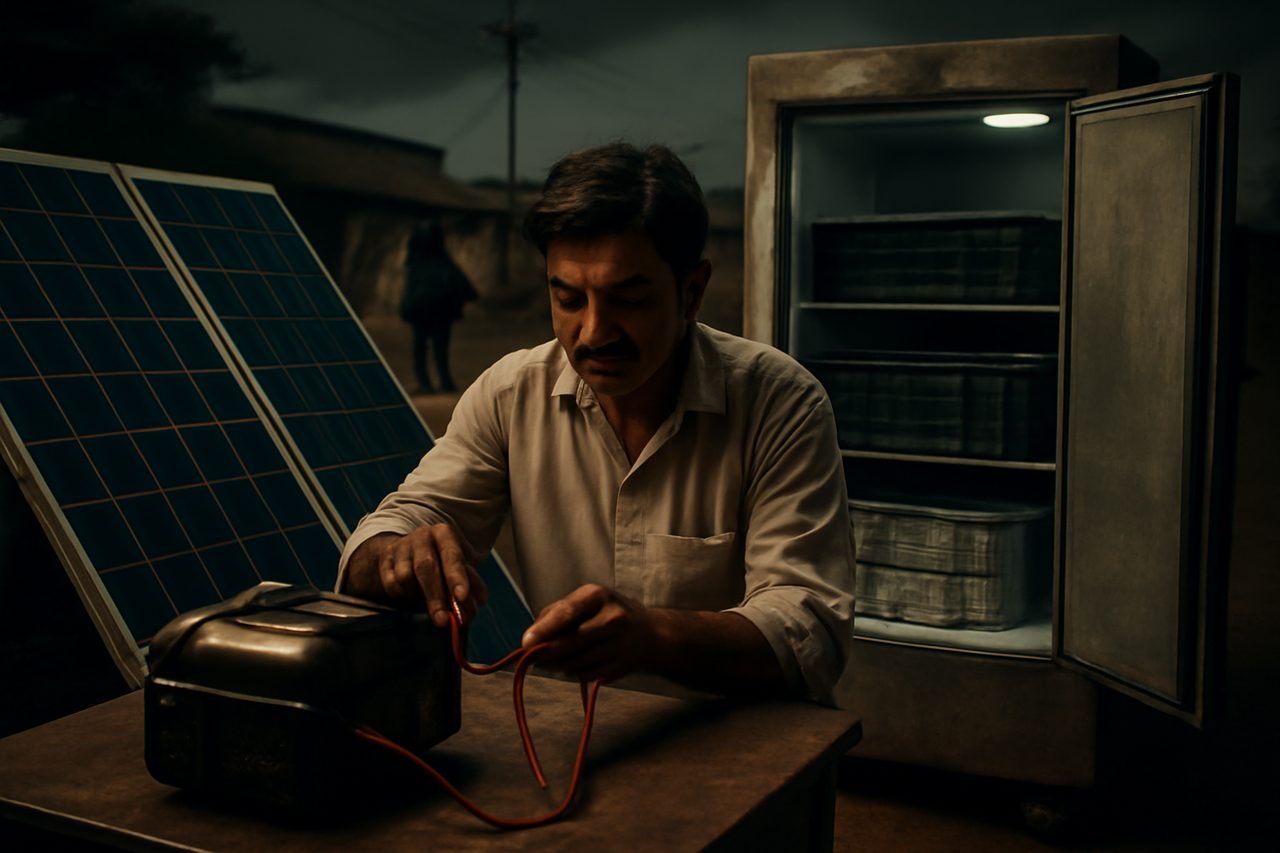
Among all NGO energy-access segments, decentralized cold chain is one of the most investable in 2026. Post-harvest losses in perishables remain significant across horticulture and fisheries. A village or block-level solar cold room, when linked with pre-cooling, grading, aggregation and market access support, can materially improve farmer realisation.
A practical project configuration in India today often looks like this:
- 10-30 kW rooftop or ground-mounted solar PV
- 20-80 kWh battery depending on outage profile and operating hours
- 5-20 MT modular cold room, with temperature band tailored to produce type
- Smart metering, remote monitoring and access control
- Optional backup through grid or small DG only for contingency
Indicative 2026 economics vary by state and application, but practitioners commonly see:
- Small 5 MT solar-assisted cold rooms: about Rs 18 lakh to Rs 28 lakh all-in, depending on insulation specs, battery sizing and civil work
- Mid-scale 10-15 MT systems: about Rs 30 lakh to Rs 55 lakh
- Levelized delivered power cost from optimized captive solar systems: often around Rs 4.5-6.5/kWh equivalent for the solar component, versus diesel-based effective supply that can exceed Rs 18-25/kWh for small users
- User charges for storage services: roughly Rs 0.7-1.8/kg/day depending on crop, season, utilisation and local competition
The key is not capex minimisation alone. It is throughput assurance. A cold room with 20-25% utilisation will fail regardless of subsidy. The same asset at 55-70% seasonal utilisation, integrated with market linkage and aggregation, can support O&M, debt servicing in blended structures, and reserve creation.
For NGOs, this means energy access must be bundled with value-chain development. Standalone hardware deployment is not enough. The programme needs farmer onboarding, commodity mapping, load scheduling, local operator training and digital transaction records.
Funding architecture: CSR-first, grant-linked and revenue-backed models
Most NGO-led productive energy projects in India still need concessional capital support, but the structure has matured in 2026. The strongest designs avoid 100% grant dependency and use CSR or philanthropic money to absorb early-stage risks that commercial lenders will not take.
A workable capital stack often includes:
- CSR grant for community infrastructure, training and first-loss support
- Foundation or donor capital for technical assistance and market linkage
- Enterprise equity from developer, social enterprise or local SPV sponsor
- Senior debt only after revenue contracts, user history or anchor offtake are visible
- In some cases, state subsidy where the asset overlaps with agriculture, livelihood or cold-chain schemes
For Indian companies planning CSR deployment under Section 135-linked programmes, productive-use energy is easier to defend internally than pure asset donation because it can be tied to livelihoods, health, gender inclusion and resilience. But boards increasingly scrutinise durability. They ask whether the asset will still operate after three years and whether local institutions can maintain it.
That is where outcome-based structuring helps. Instead of funding only procurement and installation, NGOs and corporate CSR teams should tie disbursement tranches to operational milestones such as:
- Days of uptime above 95%
- Number of paying enterprise users onboarded
- Volume stored or processed per month
- Increase in farmer price realisation versus baseline
- Reduction in diesel consumption
- Number of women-led enterprises using the facility
This approach improves accountability while preserving the social mandate. It also creates a data room for future lenders.
From a lender’s perspective, projects become more financeable when they show one or more of the following:
- An anchor institution such as an FPO, dairy union, hospital, panchayat federation or cooperative
- Seasonal demand mapping across at least two crop cycles
- Escrow or collection waterfall for user fees
- O&M contract with response-time commitments
- Remote performance monitoring and fault logging
Tariff design and bankability: what actually works on the ground
Tariff design is where many NGO energy-access projects become fragile. If the community is told power or cold storage is “free” because a grant exists, utilisation may rise initially but collections weaken, and long-term service quality collapses once equipment needs maintenance. Productive-use energy should therefore be priced, but priced intelligently.
In 2026, four tariff principles are proving useful:
- Keep the tariff lower than diesel-backed alternatives on an all-in basis
- Align pricing to revenue events, not just energy units
- Use seasonal structures where crop cycles are concentrated
- Preserve a maintenance reserve in the tariff or service fee
For example, a solar cold room may not bill by kWh at all. It may bill:
- Per crate per day
- Per kilogram per holding period
- Through seasonal subscription for an FPO
- Through fixed anchor charges plus variable use charges
A village processing hub may bill per kilogram milled, pressed or ground. A health-energy system may use a service contract model funded by a hospital trust or public-health programme rather than direct retail billing.
The comparison benchmark should be explicit. If a rural entrepreneur today uses a small diesel genset, their effective electricity cost can be well above Rs 20/kWh after fuel, transport, maintenance and low load factor. If a DRE system offers dependable supply equivalent at Rs 8-12/kWh retail, or service pricing that lowers total operating cost by 20-40%, the proposition is credible.
However, bankability depends on more than pricing. Developers and NGOs should underwrite utilisation conservatively. Assume downtime, lower first-year occupancy, and working-capital stress during agricultural shocks. Debt tenors should reflect asset life and seasonal cash flow. Collection design should include digital options but not rely exclusively on smartphone penetration.
Policy and scheme alignment in 2026
A serious NGO energy-access strategy in India should map productive-energy projects to existing policy architecture instead of treating them as isolated CSR installations. Relevant 2026 touchpoints commonly include central and state schemes related to livelihoods, agriculture infrastructure, cold chain, women’s collectives, rural health and distributed renewables.
The exact fit varies by state, but practitioners should assess alignment with:
- PM Kusum where irrigation and agricultural daytime loads can be linked, particularly around solarisation and rural feeder quality issues
- National and state horticulture missions for post-harvest and cold-chain support
- Dairy development and cooperative infrastructure programmes in milk clusters
- NRLM-linked SHG enterprise promotion for women-run rural businesses
- Tribal development, aspirational district and rural livelihood programmes
- Public health supply-chain initiatives where vaccine or medicine refrigeration is relevant
Interfacing with DISCOMs is also important. Even when the project is behind-the-meter or standalone, interconnection, backup supply, sanctioned load and net-metering or gross-metering rules may affect economics. In some states, commercial and institutional tariff categories for rural enterprises still range around Rs 6.5-9.5/kWh, with demand charges and fixed charges adding pressure for small operators. DRE systems must be designed with the actual tariff category in mind, not assumed household rates.
Utilities should not view such projects as demand loss alone. In weak rural networks, productive-load DRE can reduce transformer stress, flatten expensive diesel use and create better-served local commerce that ultimately improves paying demand. Partnership models where utilities support reliability upgrades while NGOs or developers finance end-use productive assets deserve more attention.
MRV that matters: from connection counts to livelihood and resilience metrics
For the NGO segment, weak measurement remains a major bottleneck. Too many projects still report installed kW, number of villages and beneficiary counts while failing to prove operational impact. In 2026, funders increasingly expect auditable MRV that links energy service to economic and social outcomes.
A practical MRV stack for productive-use community energy should track five layers:
- Asset performance: generation, battery cycles, downtime, fault events, temperature logs for cold storage, equipment run-hours
- Service delivery: number of active users, storage occupancy, processing throughput, uptime during business hours
- Financial outcomes: collections, arrears, O&M cost, reserve balance, unit economics by season
- Development outcomes: farmer price realisation, spoilage reduction, enterprise income changes, women user share, jobs supported
- Resilience outcomes: diesel displacement, avoided outage losses, critical health-service continuity
Cold-chain projects are particularly suited to stronger MRV because usage is measurable. For example, an NGO-run solar aggregation hub can record:
- Tonnage handled per crop
- Average days stored
- Commodity-wise spoilage reduction percentage
- Price spread between immediate distress sale and delayed sale
- Net income improvement for member farmers
- Litres of diesel avoided compared with baseline transport and backup practices
This data is useful well beyond donor reporting. It helps developers improve load forecasting, supports lenders in underwriting repeat projects, and gives policymakers evidence that productive-use DRE delivers more durable benefits than isolated asset grants.
MRV should also be designed for low-friction field execution. Overcomplicated survey tools create poor data quality. The best systems combine machine data from controllers and sensors with short periodic field validation and digital cash-flow records.
Implementation playbook for NGOs, developers and financiers
If the goal is to build replicable NGO energy-access portfolios in 2026, the delivery model should be cluster-based rather than project-by-project. A single village asset carries too much utilisation risk. A cluster of 10-30 sites across one value chain and state geography creates procurement scale, shared O&M and stronger financing logic.
A practical implementation sequence is:
- Identify commodity or service clusters with predictable demand: dairy, horticulture, fisheries, health, women-led processing
- Map current energy use, diesel dependence, outage profile and value leakage
- Choose a service model: own-operate, cooperative-managed, franchise, or developer-led SPV with NGO facilitation
- Build a blended capital plan with CSR, donor support, sponsor equity and phased debt
- Lock in O&M, telemetry and local technician capacity before EPC award
- Design tariff and collection pathways linked to user cash cycles
- Set MRV baselines before commissioning
The biggest mistakes to avoid are equally clear:
- Over-sizing solar and battery without proven load growth
- Treating grants as a substitute for collections discipline
- Ignoring commodity seasonality
- Installing assets without a local operator incentive plan
- Under-budgeting service and maintenance over five years
- Reporting only social outputs without commercial metrics
For C&I buyers, RE developers and lenders watching this segment, the message is straightforward. NGO energy access is no longer only a philanthropic side lane. Productive-use rural energy can become a serious distributed infrastructure category when demand is tied to income-generating activity and backed by disciplined MRV. The winners in 2026 will be firms that can integrate advisory, engineering, financing and field operations into one execution framework.
Growthifye supports NGOs, corporates, developers and institutions with energy-access strategy, techno-economics, EPC planning, fund structuring, tariff design and impact MRV for rural solar, clean cooking and community energy portfolios. To discuss a productive-load DRE or solar cold-chain programme, contact Growthifye’s advisory desk.
About the author

Founder & CEO, Growthifye — engineering and financing India's clean-energy transition.
Want this analysis applied to your project?
Talk to our team