
Monetising India's bus depots: the 200-site opportunity hiding in plain sight
By Sudarshan Karweer · sudarshan@growthifye.com · +91 84510 99371 (Call / WhatsApp) · 2026-08-26
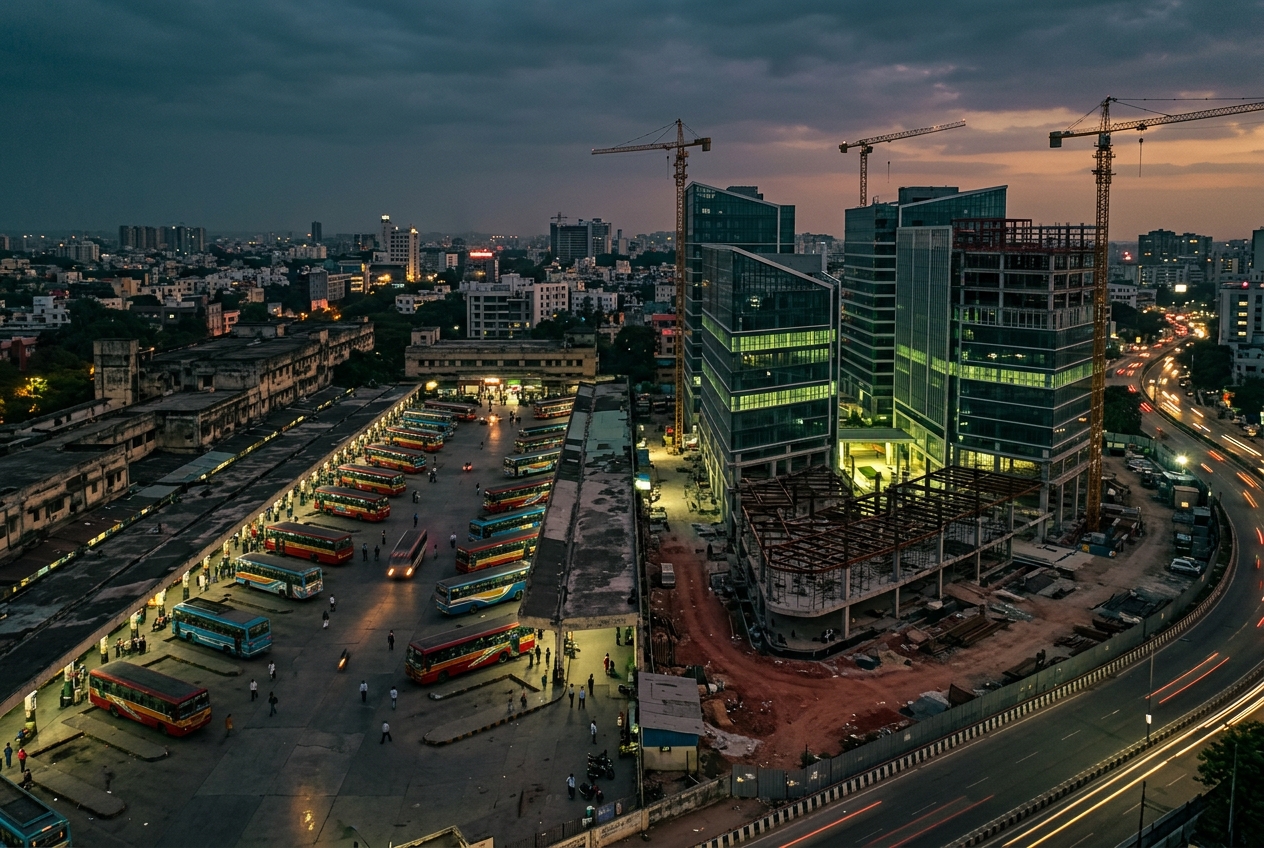
State transport undertakings are sitting on one of India's most under-priced real estate portfolios. Maharashtra alone: MSRTC operates hundreds of depots and bus stations, and over 200 of these sites are now being evaluated for monetisation. Most occupy the commercial heart of their towns — land acquired decades ago, carried at historical cost, generating nothing beyond bus operations. The National Monetisation Pipeline put a policy frame around this; what has been missing is disciplined, site-by-site execution.
Why transit assets are different
A bus depot is not a land parcel with a bus problem. It is an operating public service with a land opportunity. That distinction drives everything: the concession must rebuild and hand back a modern bus terminal first, and only the genuinely surplus development potential can be monetised. Structures that ignore this — pure land leases, aggressive FSI assumptions, hotel towers in markets that cannot absorb them — fail at the bid table or, worse, after award.
The workable instrument in most cases is a DBFTL-style concession: the private partner designs, builds and finances the redevelopment, transfers the transport infrastructure back to the authority, and operates the commercial component on a long lease — typically 49 years with renewal. The authority gets a new terminal at zero capital cost plus recurring lease income; the concessionaire gets a bankable commercial annuity.
What 200+ sites teach you very quickly
Running feasibility across a portfolio, rather than one trophy site, changes the conclusions:
- Location quality diverges wildly. A hill-station gateway like Lonavala can support hospitality-led redevelopment and clears equity return floors comfortably. A suburban industrial-belt site may not absorb even modest retail space for a decade.
- Mandatory capex is the silent killer. The bus-station rebuild is non-negotiable and largely fixed; if the monetisable component is small, the concession arithmetic collapses regardless of how the term sheet is dressed.
- Not tendering is sometimes the right answer. Our Talegaon analysis tested three concession configurations and none cleared bankability floors. Advising the authority to restructure — defer, unbundle the works from the commercial rights, or bundle weak sites with strong ones — protected it from a failed bid process and a stranded obligation.
- Bundling is the portfolio's superpower. Pairing high-absorption sites with marginal ones inside a single concession spreads the mandatory capex burden and widens the bidder pool — but only if the financial model prices each site honestly first.
The model is the mandate
Every recommendation above stands or falls on a full three-statement financial model: construction phasing, lease and revenue build-up, operating costs, debt sculpting, DSCR, working capital, project and equity IRR, and sensitivity analysis on the two or three assumptions that actually move the answer — absorption, rental escalation and capex. Authorities that tender on a broker's one-page yield estimate invite either no bids or aggressive bids that get renegotiated later. Lenders will model it anyway; the authority should get there first.
What authorities should do now
- Triage the portfolio into monetise-now, restructure-first and hold buckets using a consistent readiness scorecard — before any RFP is drafted.
- Fix risk allocation early: ROW, approvals and existing-operations continuity belong with the party best placed to manage them, not the party easiest to burden.
- Publish a credible pipeline. Concessionaires and financiers mobilise for programmes, not one-off tenders; a sequenced 200-site pipeline commands better terms than 200 isolated auctions.
- Protect the service covenant. Passenger experience is the political licence for the entire programme — the terminal spec, transition plan and O&M obligations deserve as much rigour as the lease financials.
Transit asset monetisation is not a real estate trade with a public inconvenience attached. Done with honest feasibility, disciplined structuring and models that survive lender scrutiny, it is self-funding public infrastructure — and the 200+ depots now under evaluation are the clearest demonstration in the country of how much value is waiting to be unlocked.
How Growthifye helps
We advise authorities and investors across the full monetisation cycle — asset diagnostics, InvIT/TOT/DBFTL structuring, PPP concession design, bid process management and buy/sell-side transaction advisory — every mandate anchored in a bankable financial model. Talk to our Asset Monetisation, PPP & Transaction Advisory desk.
Explore Growthifye's related capabilities
This analysis connects directly to our advisory practice: Brownfield asset monetisation · PPP structuring & concession design · Bid process management · Transaction Advisory (Sell-side).
About the author

Founder & CEO, Growthifye — engineering and financing India's clean-energy transition.
Want this analysis applied to your project?
Talk to our team